Hydraulic boundary conditions
In a seepage / steady-state flow analysis (see Steady state analysis) the water flow is governed by the hydraulic boundary conditions, i.e. the total head (potential) ϕ values assigned to the boundary nodes of the model.
Assigning the total head
After selecting the relevant boundary nodes (Tools panel), open the Boundary conditions window and select the Hydraulic tab. Two modes are available.
Total head value [m] — a fixed total head assigned to the selected nodes. It is used where the head is known and constant, for example the nodes in contact with an upstream water level (the total head equals elevation + water height). These nodes define an equipotential surface.
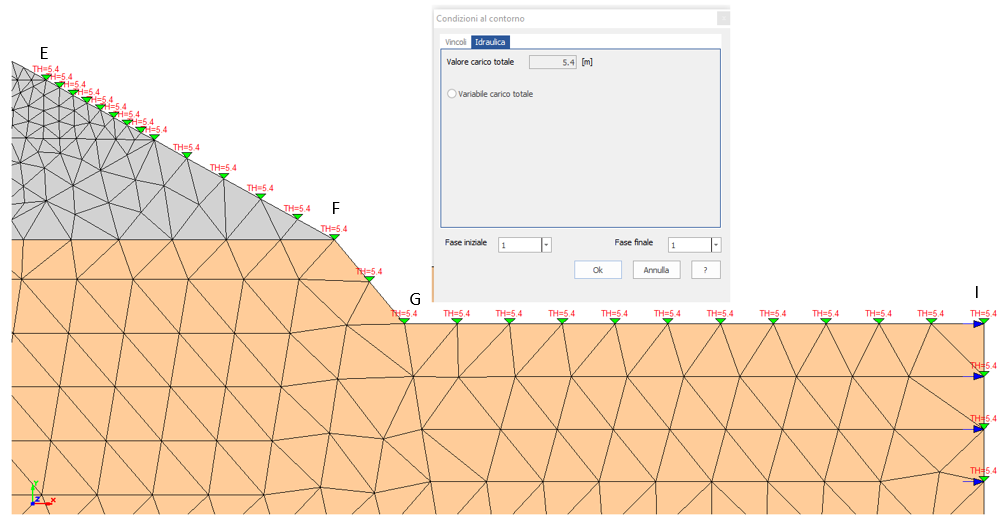
Fixed total head (upstream side)
Variable total head (checkbox) — a variable total head: the software automatically assigns each node a total head equal to its elevation. It is used where the position of the free surface is not known in advance (for example the downstream face or the crest), thus allowing the possible formation of a phreatic surface.
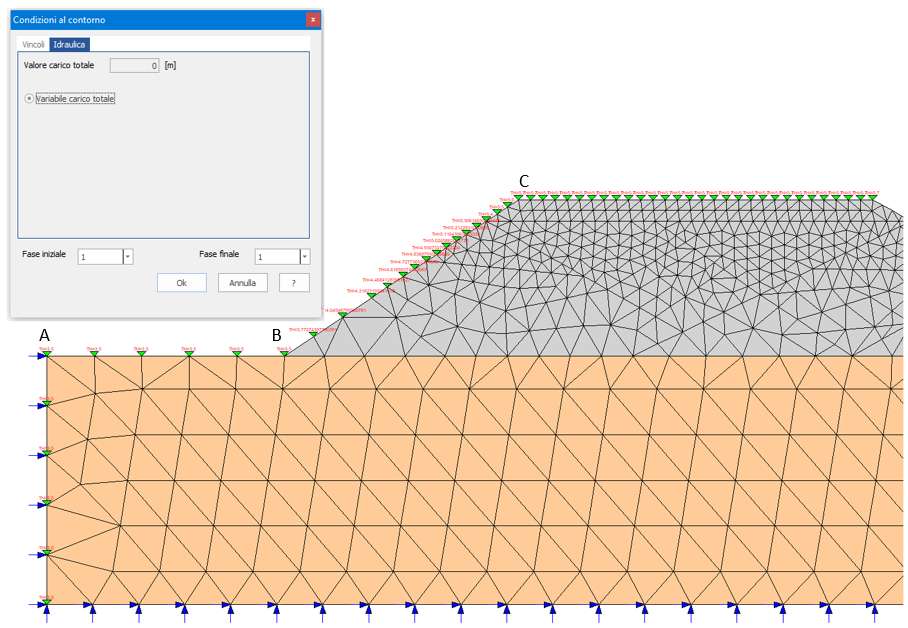
Variable total head (downstream side and crest)
The Stage start / Stage end fields define in which calculation stages the hydraulic constraint is active.
Potential type
In the data panel of the nodes with assigned head (Total heads) each node reports a Potential type code, which must be consistent with the chosen mode:
| Potential type | Meaning |
|---|---|
| 1 | Fixed total head |
| 2 | Variable total head |
| 0 | Invalid — error: it must be set to 1 or 2 |
Common mistake
Leaving the Potential type at 0. Every node with an assigned hydraulic head must have Potential type 1 or 2; otherwise the analysis reports a potential-type error ("Unknown potential type").
Hydraulic material properties
The hydraulic parameters are assigned in Material properties → Hydraulic properties tab, for each material:
- Permeability X (kx) [m/s]
- Permeability Y (ky) [m/s]
The two values can differ from each other, so as to model anisotropic soils (different permeability in the x and y directions).
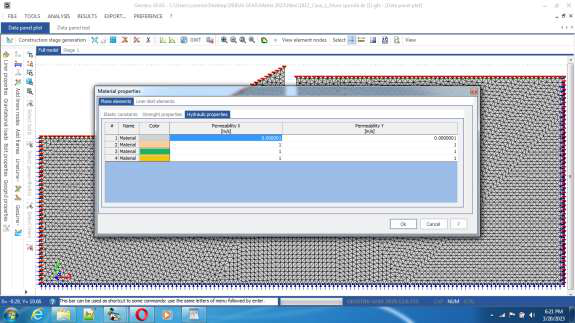
"Hydraulic properties" tab: permeability in the X and Y directions
See also
- Steady state analysis — theory and formulation of the seepage problem, the GFAS iterative procedure (free-surface and air element handling) and a worked example (earth embankment).