LRFD
SLOPE STABILITY ANALYSIS ACCORIDING TO:
AASHTO – LRFD BRIDGE DESIGN SPECIFICATIONS – 9TH EDITION
The LRFD approach consists in checking the following equation:

Where Q and R can represent forces, as well as stresses, deformations, displacements, etc. In this equation, Q represents an amplified value of actions, while R is a reduced value of resistances. The fundamental concept of LRFD design is expressed by the following relationship:

In which
Q : factored load
Qi : force effect
ηi : load modifier
γi : load factor
Rr : factored resistance
Rn : nominal resistance (i.e., ultimate capacity)
φ : resistance factor
According to the Specifications, it is necessary to perform the slope stability analysis using the Strength I approach. However, also the other two verifications (Service I e Extreme Event I) have to be performed.
However, referring to the Strength I approach, it is prescribed to employ a unitary load factor γi for all the loads included in this combination. Therefore, the verification can be rewritten as follows:
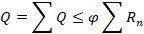
The resistance factor, φ, has to be evaluated as specified in the following.
In SLOPE, the LRFD approach is equivalently applied using the following equation:
where
Therefore, the coefficient to be input in SLOPE takes the following values:
This coefficient has to be given as input in SLOPE as shown in the following window, concerning the main parameters.